A first internship interview can feel intimidating when you do not yet have years of work experience. The good news is that employers do not expect a student to answer like an experienced manager. They usually want evidence that you understand the opportunity, can learn, communicate clearly and connect your academic, volunteer, part-time or extracurricular experience to the work.
Quick answer: Prepare for your first internship interview by researching the role and employer, identifying three to five relevant strengths, building four short STAR stories, practicing answers aloud, preparing thoughtful questions and checking the interview logistics. Use examples from classes, projects, clubs, volunteering, sports and part-time jobs when you do not have formal experience.
What Employers Look for in a First-Time Intern
An internship interview is not a test of whether you already know everything. It is a structured conversation about your potential and your fit with the opportunity. Employers may assess whether you:
- understand the basic purpose of the role;
- can explain why the organization and field interest you;
- have transferable skills such as communication, teamwork, organization and problem-solving;
- take responsibility and learn from feedback;
- can contribute reliably while developing new skills.
Harvard’s Mignone Center for Career Success notes that interviewers commonly evaluate qualifications, organizational fit, reasons for applying, potential contribution and transferable skills. That means a student can give a strong interview without having held a previous internship.
How to Prepare for Your First Internship Interview
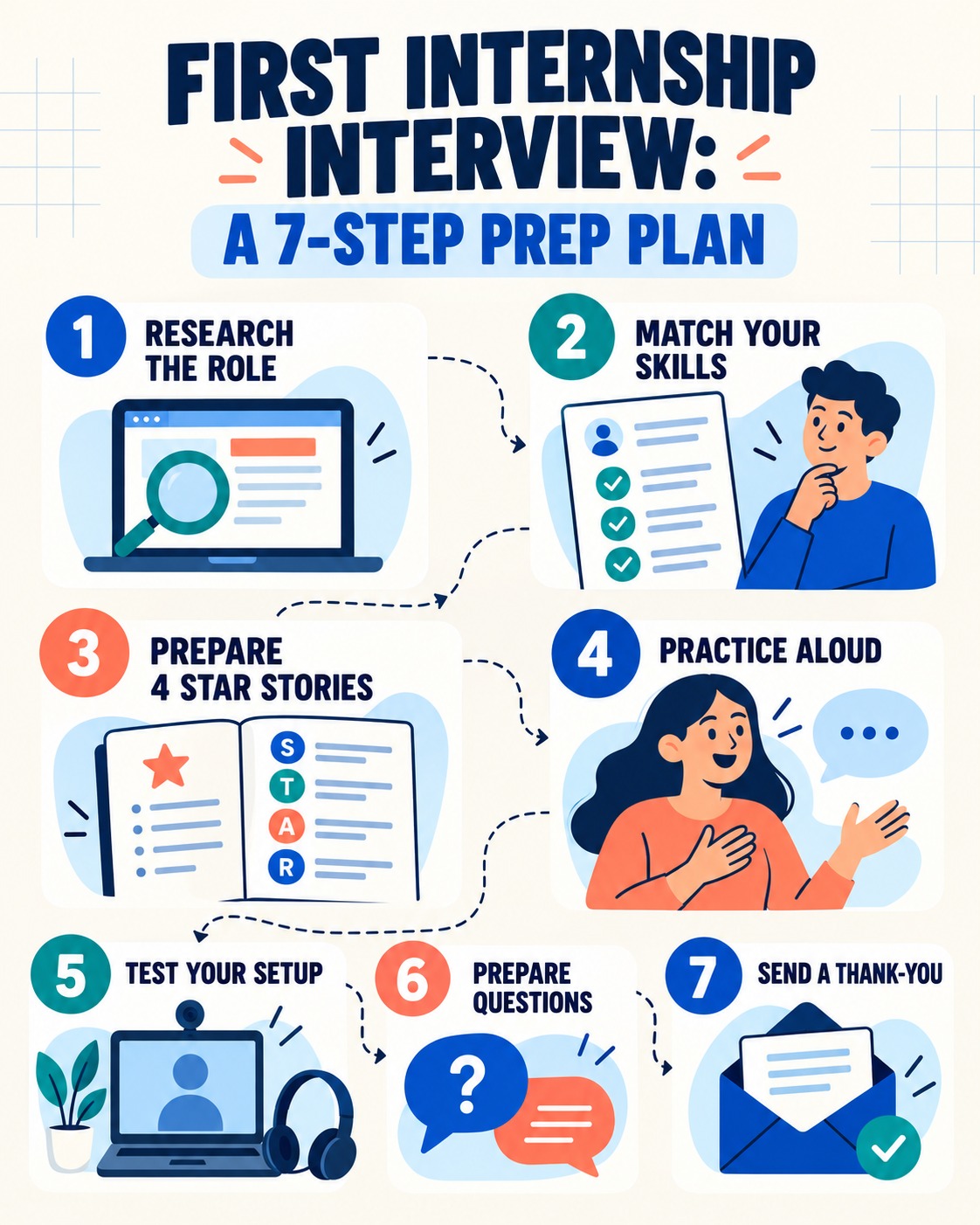
1. Study the internship description
Read the description line by line. Highlight the responsibilities, required skills, preferred qualifications and tools mentioned. Create two columns: “What they need” and “My evidence.” Your evidence may come from a course assignment, group project, student society, family responsibility, volunteer role, independent project or paid job.
For example, if the role requires “attention to detail,” you might discuss checking data in a research project, proofreading a student newsletter or managing event registrations. Do not claim expertise you do not have. Explain the level you have reached and how you used the skill.
2. Research the employer
Review the organization’s official website, recent announcements, products or services, mission and the team connected to the internship. Note two facts that genuinely interest you. Research helps you answer “Why do you want to work here?” with specifics instead of generic praise.
A useful answer connects three ideas: what the organization does, why the internship fits your interests and what you hope to contribute or learn.
3. Prepare a concise introduction
Your answer to “Tell me about yourself” should usually be a focused professional summary rather than your life story. A simple structure is:
- Present: your degree, subject or current focus;
- Evidence: one or two relevant projects, activities or skills;
- Direction: why this internship is a logical next step.
Example: “I’m a second-year economics student who has become especially interested in market research and data analysis. In a recent team project, I cleaned survey data and presented the main findings to our class. I also help organize events for our student association, which has strengthened my communication and planning skills. I’m interested in this internship because it would let me apply those skills to real customer and market questions while learning from an experienced team.”
4. Build four adaptable STAR stories
Behavioral questions often begin with “Tell me about a time…” Use the STAR framework to keep your answer clear:
- Situation: give the essential context;
- Task: explain your responsibility or goal;
- Action: describe what you personally did;
- Result: state the outcome and what you learned.
Prepare stories about teamwork, solving a problem, meeting a deadline and handling feedback or a setback. One story can often answer several questions, but adjust the emphasis to the question asked.
Student STAR example: “In a five-person class project, our research tasks were falling behind because responsibilities were unclear. I created a shared task list, asked each teammate to confirm an owner and deadline, and scheduled a short midpoint check. We completed the report on time and received strong feedback for its organization. I learned that making ownership visible can prevent confusion without micromanaging the group.”
5. Practice aloud, not only in your head
Writing notes is useful, but spoken practice reveals long answers, filler words and unclear transitions. Record yourself or practice with a friend, career adviser or mock-interview tool. Aim to remember your main points rather than memorizing every sentence. A memorized script can sound rigid and may become difficult to adapt when the question changes.
UC Berkeley Career Engagement emphasizes that interview skill improves through actual practice. Ask the person helping you to evaluate clarity, relevance, pace and whether your evidence supports your claims.
6. Prepare the interview setup
For a video interview, test the link, camera, microphone, internet connection and device power. Choose a quiet, well-lit space with a simple background. Keep your résumé, the job description, a pen and brief notes nearby, but avoid reading answers from the screen.
For an in-person interview, confirm the address, route, travel time, building entry instructions and interviewer’s name. Plan to arrive nearby early without checking in excessively early. Wear clean, comfortable clothing that fits the organization’s environment.
7. Prepare questions for the interviewer
Questions show that you are evaluating the opportunity thoughtfully. Prepare at least three, because some may be answered during the conversation.
- What would a successful intern accomplish during the first month?
- What kinds of projects have previous interns supported?
- How does the team give interns feedback?
- Which skills would help someone learn quickly in this role?
- What are the next steps in the selection process?
Avoid asking for information that is clearly available on the employer’s homepage. Questions about compensation or scheduling are legitimate, but choose the appropriate stage and ask professionally when the information has not already been provided.
Common First Internship Interview Questions and Sample Approaches
Why do you want this internship?
Connect the work to your interests, show that you researched the organization and identify the skills you can contribute. Avoid saying only that you need experience for your résumé.
What experience do you have?
Broaden “experience” beyond formal employment. Discuss relevant coursework, projects, volunteering, clubs, caregiving, sports, freelance work or personal projects. State what you did, the skill involved and the result.
What is one of your strengths?
Choose a strength that matters to the role and support it with evidence. “I am organized” is a claim; explaining how you coordinated a deadline-heavy group project is evidence.
Tell me about a challenge or mistake
Select a real but appropriate example. Explain your responsibility without blaming others, show the corrective action you took and end with what changed in your approach. You do not need to present a dramatic failure.
How do you manage competing deadlines?
Describe your actual system: reviewing requirements, breaking work into tasks, prioritizing by impact and deadline, using a calendar or task list and communicating early if a risk appears.
Why should we choose you?
Summarize two or three relevant strengths and your motivation to learn. Keep the answer grounded: “I bring…” is more credible than claiming you are the best candidate.
What to Do When You Do Not Know an Answer
Pause briefly. If the question is unclear, ask for clarification. If it concerns a tool you have not used, be honest and connect it to something related: “I have not used that platform yet, but I used a similar tool in a class project and learned it by completing…” You can also explain how you would approach the problem.
Do not invent experience. A truthful answer that demonstrates reasoning and learning ability is stronger than a confident claim that cannot withstand a follow-up question.
First Internship Interview Mistakes to Avoid
- Giving generic answers: connect each answer to the role.
- Apologizing for being inexperienced: focus on relevant evidence and readiness to learn.
- Speaking only about “we”: explain your personal contribution to team results.
- Reciting your résumé: add context, decisions and lessons.
- Answering for too long: lead with the relevant point and stop when the example is complete.
- Having no questions: prepare questions that help you understand the work.
- Skipping a technology check: test before a virtual interview.
What to Do After the Interview
Within 24 hours, send a short thank-you email when you have the interviewer’s contact information. Thank them for their time, mention one specific topic from the conversation and briefly restate your interest. Do not send repeated follow-ups.
Write down the questions you received and note which answers you want to improve. If the employer gave a decision timeline, wait until it passes before requesting an update. Continue applying elsewhere while you wait.
First Internship Interview Checklist
- Read the description and match your evidence to the requirements.
- Research the employer, team and field.
- Prepare a 60–90 second introduction.
- Build four adaptable STAR stories.
- Practice common questions aloud.
- Prepare three thoughtful questions.
- Confirm the time, time zone, location or video link.
- Test your technology and prepare your documents.
- Send a concise thank-you after the interview.
Frequently Asked Questions
How long should I prepare for a first internship interview?
There is no universal number of hours. Begin as soon as the interview is scheduled and divide the work across research, story preparation, spoken practice and logistics. Several focused sessions are usually more useful than one late-night cram.
Can I use class projects as interview examples?
Yes. Class projects are appropriate when they demonstrate a skill relevant to the role. Explain the project briefly, identify your personal contribution and describe the outcome.
Should I bring notes?
Brief notes and questions are fine, especially in a virtual interview, but do not read full answers. Maintain a natural conversation and use notes only as prompts.
What should I say if I have no work experience?
Use evidence from coursework, group assignments, volunteering, clubs, sports, caregiving, independent learning and personal projects. Employers need examples of how you work, not only job titles.
How soon should I send a thank-you email?
A concise message later the same day or within 24 hours is a practical standard. Personalize it to the conversation and proofread it before sending.
Turn Preparation into Confidence
Your first internship interview does not require a perfect performance. It requires honest, relevant evidence and a clear explanation of why you want the opportunity. Research the role, prepare adaptable stories and practice aloud until your answers sound like you—not a script.
Continue your preparation with our LinkedIn profile guide for students and recent graduates and our LinkedIn profile checklist.